

The Four Types of Fractional - and how to diagnose Fractional Drift
“I’m a Fractional CMO.”
Okay. Which fraction?
Calling yourself a fractional executive is super popular right now. And, in my opinion, incredibly challenging as a positioning tool.
Lex Roman recently wrote an excellent piece for Revenue Rulebreaker asking whether independent experts should add “fractional” to their titles. I was one of 16 people they interviewed, and the answer was basically: it depends.
Sometimes the label helps the right buyers find you. It can signal seniority, set pricing expectations, or explain why you’re embedded in an organization without being a full-time employee. And fractional as a billing arrangement—a flat rate billed monthly instead of tracking and billing for every hour—can simplify invoicing and create predictability for you and your client.
The problem is that the label doesn’t tell anyone what you’re actually doing or what organizational problem you’re solving.
I’ve seen fractional executives who legitimately run an entire function part-time. I’ve also seen fractional leaders brought in to provide direction for a team, lead a strategic project, or advise the CEO.
Those are all legitimate kinds of work. But they are not the same work.
And if you don’t know which fraction you’re selling—and the organization doesn’t know which fraction it’s buying—fractional becomes a recipe for failed expectations, scope creep, and implied responsibility without the time or authority required to get the promised results.
The layers of a role
Suzan Bond breaks any senior leader’s role into two broad levels: functional and organizational.
In functional leadership, leaders are:
Executing deliverables and running day-to-day operations
Managing teams and individual contributors
Leading functional initiatives and functional strategy
In organizational leadership, leaders are:
Partnering with peers on organization-wide strategy
Guiding initiatives that cut across teams and stakeholders
Supporting organizational talent planning
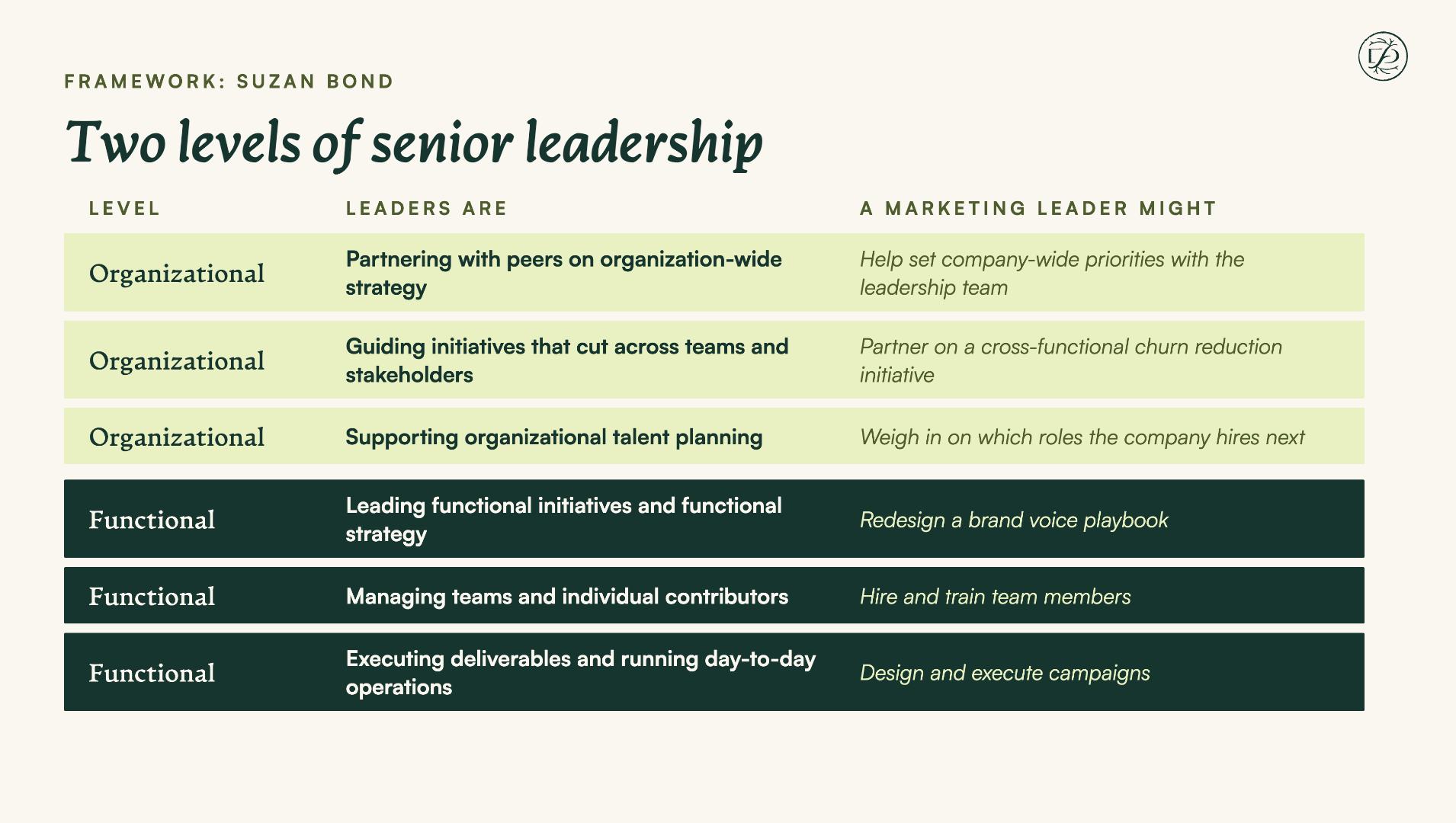
For example, a marketing leader might design and execute campaigns, hire and train team members, and redesign a brand voice playbook. That same leader might also partner on a cross-functional churn reduction initiative, where marketing changes campaign language for a particular segment while sales changes part of its process and customer success changes how it supports those customers.
The same distinction exists in other functions. In addition to day-to-day responsibilities and managing a team:
A finance leader might redesign the company’s forecasting process while participating in a company-wide profitability effort that changes pricing, staffing, and service delivery.
An HR leader might rebuild the performance management process while participating in an organizational restructuring.
An operations leader might redesign a fulfillment process while contributing to a broader decision about which customer segments the company can profitably serve.
A senior leader’s job can touch all of these layers.
So if you’re “fractional,” which Fraction are you actually signing up for? And what tends to go wrong with each one?
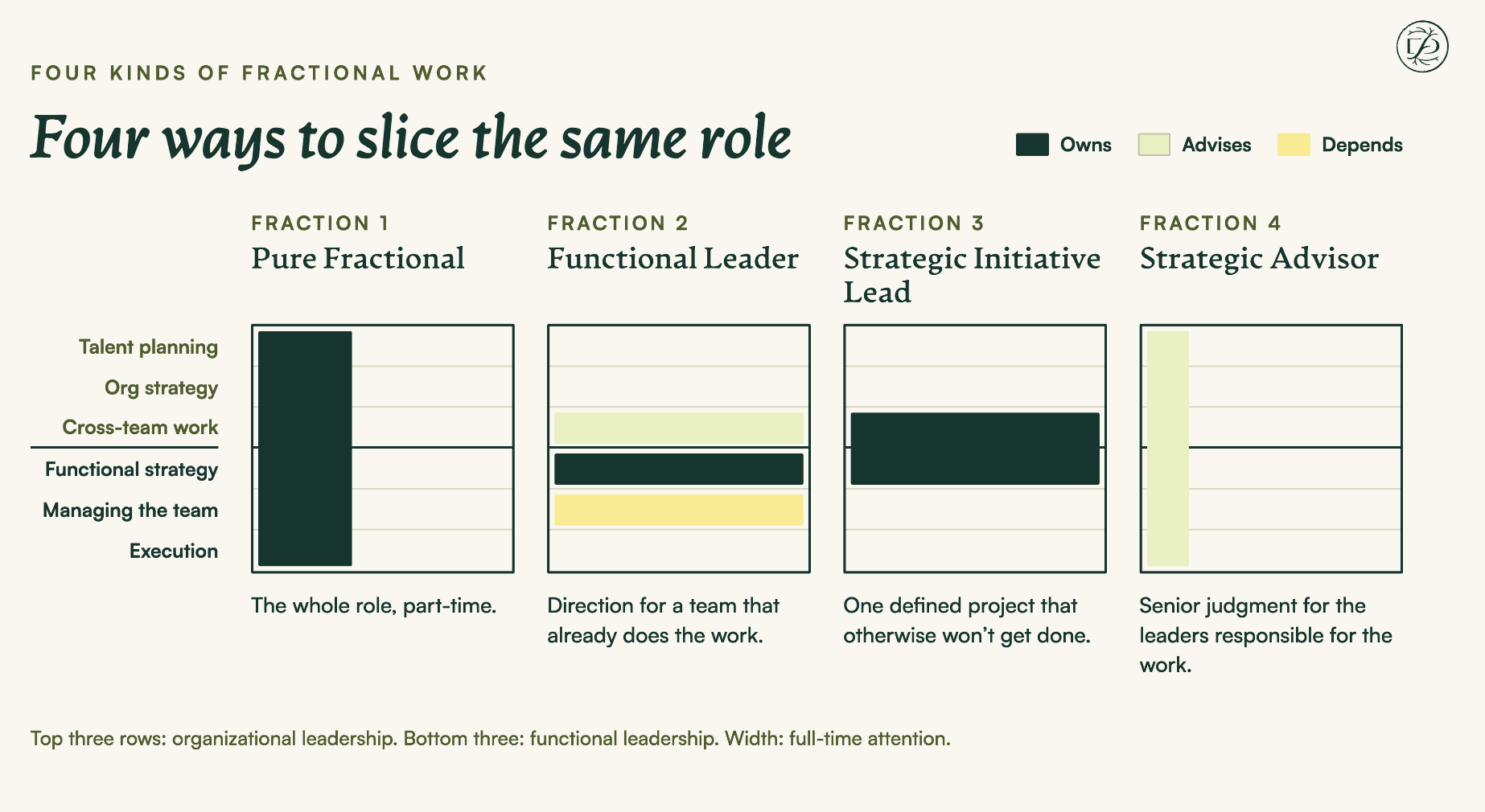
Fraction 1: The Pure Fractional
This is the most literal version of fractional work: you get the whole role, just part-time.
As a fractional CFO, you’re running cash-flow projections, working through controlling issues, overseeing month-end close, managing the finance team, leading functional improvements, and participating in organizational strategic planning. The company doesn’t need—or perhaps can’t yet justify—a full-time CFO, but it does need the responsibilities of the CFO role covered.
This was my role both times I worked as a true fractional COO. I was involved in organizational strategic planning and ran strategic improvements for operations. I also handled day-to-day work, wrote proposals, prepared cash-flow forecasts, hired people, and onboarded team members.
I wasn’t advising someone else who was doing the operations job. I was doing the operations job, just for a fraction of the time.
And doing the job means more than doing the work. If you’re accountable for the function’s results, you generally need the authority that comes with the role: to set priorities, allocate resources, manage performance, and make—or meaningfully influence—hiring decisions.
The failure mode: Time creep
The question is whether the whole job can actually be done in less than 40 hours.
This isn’t really scope creep, because the scope was always the whole job. Time creep happens when the whole job demands more and more attention.
Decisions can’t wait until your designated fractional day. Something breaks on Tuesday when you’re not scheduled to work until Thursday. A team member needs an answer. A customer issue gets escalated. The CEO wants your input on something happening tomorrow.
At some point, “we only need you half-time” can become “we’ll pay you for half-time, but we need you paying attention full-time.”
In one of my fractional roles, the work eventually became substantial enough that I hired a full-time backfill because the company’s growth required it. In the other, the rest of my business grew to the point where I couldn’t provide the same-day or next-day attention the role required without compromising the rest of my business.
The question isn’t only whether the work fits into the hours. Does the organization effectively need someone paying attention full-time? And does the price reflect that level of responsibility and availability?
Fraction 2: The Functional Leader
In this version, the company already has people doing the work, but those people aren’t equipped to provide the senior functional leadership the company needs.
Maybe there’s a strong marketing manager who can execute campaigns but doesn’t yet have the strategic eye or taste level to set the full direction. The same gap shows up elsewhere: an HR manager can administer existing people processes but isn’t ready to design the company’s talent strategy, or a finance team can close the books perfectly well but needs someone more senior to set financial priorities and interpret what the numbers mean for the business.
The Fractional Functional Leader sets direction for the function, establishes priorities, and often reviews and approves work. They might also advise on cross-functional initiatives without being deeply involved in all of the organizational responsibilities of a full-time executive.
But “sets direction” can hide a major difference in authority and responsibility.
Can you reprioritize the team’s work, manage someone’s performance, change a role, or hire and fire? And are you expected to in order to get the promised results?
That distinction matters because the organization may expect you to be accountable for results you don’t actually have the authority to produce.
The failure mode: Responsibility creep
Say you’re the fractional CMO. You set the campaign strategy during your monthly or quarterly planning call, but the campaign isn’t delivered on time, or the assets aren’t good enough.
Are you expected to step in and fix it, or simply provide feedback?
The same thing happens elsewhere. The HR team doesn’t implement the new performance process. The finance team consistently misses the forecasting deadline or their deliverables are filled with errors.
Are you responsible for providing direction, or are you responsible for the execution too?
If you’re expected to fix the problem, you may need to manage the team, develop people, change roles, hire different talent, redesign processes, or get involved in the day-to-day work.
That’s a legitimate scope. But it’s a different scope—and a different level of responsibility and authority—from “provide senior functional direction.”
Before selling Fraction 2, ask: Are you providing functional guidance, or do you have functional responsibility? And if you have functional responsibility, do you also have the authority, time, and price required to carry it?
Neither answer is inherently better. But the organization needs to know which one it’s buying, and you need to know which one you’re selling. And ideally, you decide that before the sales conversation. If you want to provide senior functional direction without taking responsibility for day-to-day execution, that’s the Fraction you sell—and you look for organizations with capable teams that need exactly that. You don’t find a company that needs a full functional owner and then try to squeeze that need into the Fraction you’d prefer to deliver.
Fraction 3: The Strategic Initiative Lead
In this Fraction, the organization needs senior strategic capability or capacity it doesn’t currently have.
Maybe the marketing team can run ongoing campaigns, but the company needs someone to build attribution infrastructure. The finance function might need a senior person to lead a major pricing and profitability project. HR might need someone to build a new compensation architecture. Or the engagement starts with a diagnostic to identify the most impactful 1-3 projects.
Some of these projects are contained within a function. Others are inherently cross-functional. The common thread is that you’re not there to own the whole function. You’re there to lead a strategic initiative that otherwise won’t get done.
One reason people like the fractional framing is that it distinguishes this kind of person from “just a consultant.” You’re embedded, you’re actually sticking around and doing the work to get things done, not just handing off a slide deck of recommendations.
And it often starts well, with a defined first project with an objective, a sponsor, and a reason it matters now.
The failure mode: Bandwidth creep
The first project has a definition of done. The fractional engagement often doesn’t.
Finish one initiative and there’s always another process to improve, system to build, or problem to solve. Except now, unless designed for this upfront, there are often no defined checkpoints to scope and sequence initiatives or assign dedicated resources. You’re just working down a wish list of improvements.
Without defined projects, “an embedded senior leader who can work on your most important strategic priorities” becomes senior-level organizational capacity, prone to redeployment.
A fire comes up, so you’re asked to help with the fire. Someone else is overloaded, so you step in. Another priority appears, so you’re asked to look at that too. Your capacity gets spread across more and more priorities, making it harder to tie your work to concentrated, legible outcomes. Eventually, you’re supposedly leading strategic initiatives, but none of them quite get completed—and the organization wonders what it was paying for when renewal time comes.
By that point, the engagement has turned into the pitch some fractional leaders open with: “I’ll come in and help fix things. Strategy, improvements, whatever’s stuck. You get access to senior expertise for a flat rate every month.”
That’s a billing arrangement. It isn’t a scope.
This is where I’d ask whether Fraction 3 should be sold as “fractional” at all.
If you’re there to build attribution infrastructure, redesign a compensation system, or lead a pricing initiative, sell the project. You can still be embedded in the organization. You can still bill monthly. But the work has a defined objective and, importantly, an end.
A properly defined strategic project has dedicated resources, a committed sponsor, clear decision rights, milestones, and checkpoints. What does “done” mean? Who needs to participate? Has that capacity actually been committed?
And when the first project ends, what happens next? If there’s a second project, scope it like the first one. Don’t let it become “next on the list.”
There’s also the handoff. If you’re brought in to build a process, system, or capability, someone inside the organization needs the bandwidth and capability to own it afterward. Otherwise, the project isn’t really finished.
So if you’re selling Fraction 3, get very clear: are you leading a defined strategic project, or selling ongoing access to senior capacity?
If it’s the former, I’d probably sell it as a project, not as fractional. If it’s the latter, be honest that what you’re selling is capacity—and recognize how easily that capacity can be redeployed.
Fraction 4: The Strategic Advisor
Finally, there’s the fractional leader who isn’t responsible for delivering the function at all.
You might be a fractional HR leader advising the CEO on people issues, a fractional CFO helping an owner understand financial decisions without running the finance team, or an experienced sales leader advising the CEO and head of sales without managing the salespeople.
You’re there for the lens.
This is different from Fraction 2. The Functional Leader is directing or advising the team doing the work. The Strategic Advisor is advising the leaders who are responsible for the work.
There is no functional delivery responsibility. You’re providing senior judgment and perspective.
The failure mode: Results creep
What happens when you give good advice and nothing happens? Or when a function is legitimately stuck?
You recommend a change, but the leader struggles to implement it. So you’re asked to review the work. Then maybe you shadow a meeting to see what’s getting stuck. You’re added to the company Slack so you can “keep up with the conversations.” You broker a conversation between two people who aren’t aligned. You provide more detailed feedback. You step a little closer to the team.
Each request makes sense, because everyone is trying to get the result the advice was supposed to produce.
But eventually, you’re not just advising the person responsible for the work anymore. You’re increasingly involved in making sure the work gets done.
That may be a sign the organization doesn’t actually need Fraction 4. It needs someone with greater functional responsibility.
This is actually how I ended up in my first fractional role. I was initially in an advisory role, but then I was asked to hold additional sessions to scope out an Account Management process. Then to spec out an Account Management dashboard. And then, ultimately, to take over the Operations function in the interim. Thankfully, I renegotiated price and responsibility at each stage.
Four Fractions, One Title
I recently read a fairly typical case for hiring a fractional Creative Director. It gave four situations where the model supposedly makes sense.
Read each one through the four Fractions.
“You already have a design team.”
The organization has one or two capable designers, but no one senior setting direction. A fractional Creative Director supplies the strategy while its designers keep executing.
That’s Fraction 2: The Functional Leader. But what happens if the team struggles to execute? Is the Creative Director responsible for fixing that, or only for providing direction?
“You’re between full-time hires.”
The organization is in a leadership transition, a rebrand, or a period of fast growth, and needs senior creative leadership as a bridge. The fractional Creative Director keeps things moving in the right direction until it hires someone permanent.
Which Fraction is that?
Keeping things moving until the permanent hire arrives sounds like Fraction 1: The Pure Fractional, where you’re temporarily responsible for the whole job. But a rebrand could easily be Fraction 3: The Strategic Initiative Lead, where you’re responsible for one defined project.
Those are completely different engagements.
“Your output needs consistency, not volume.”
The brand looks a little different everywhere it shows up. A fractional Creative Director sets standards, builds a design system, and reviews work so everything stays consistent.
Again, is that Fraction 2: The Functional Leader or Fraction 3: The Strategic Initiative Lead?
Ongoing review and direction is functional leadership. Building a design system could be a defined strategic project with an end point. And if you’re building the system, who maintains it when you leave? Is there someone inside the organization equipped to absorb maintenance?
“You have a modest budget for a senior hire.”
Finally, there’s the financial argument: a $5,000–$15,000 monthly fractional engagement costs less than adding a full-time senior employee.
This one is the worst because it tells us nothing about the Fraction being hired.
A price isn’t a scope.
Do they need Fraction 1, Fraction 2, Fraction 3, or Fraction 4? What are you actually selling, and what does that scope include?
Fraction Drift
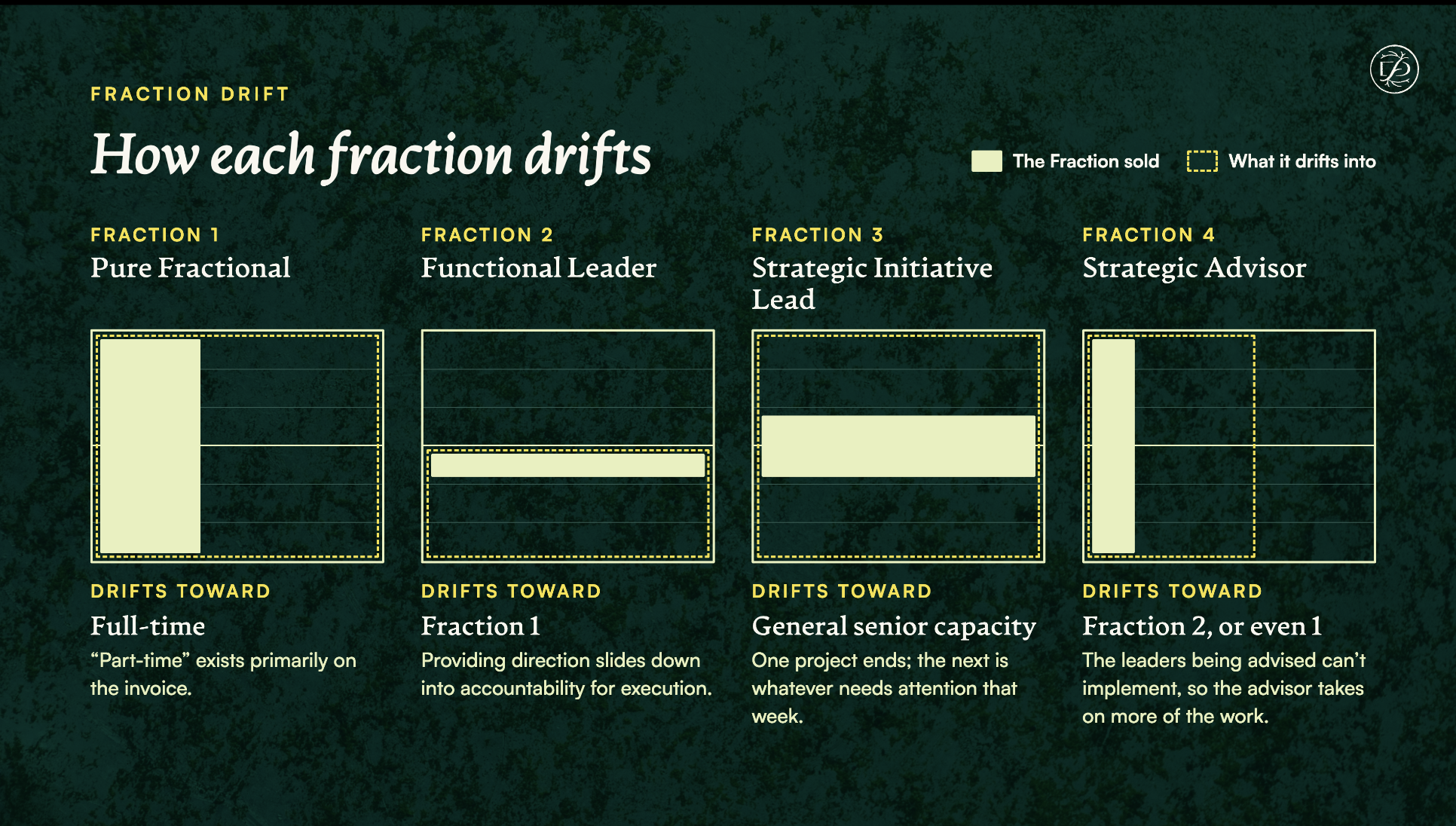
Every failure mode above is a version of the same thing: Fraction drift. The engagement starts as one Fraction and, over time, becomes another, without the terms of the engagement changing with it.
A Functional Leader starts by providing direction, then becomes accountable for execution: Fraction 2 drifts toward Fraction 1.
A Strategic Initiative Lead starts with one project that ends and then gets pulled into whatever strategic problem needs attention that week: Fraction 3 drifts into general senior capacity, with no clear definition of what that capacity is supposed to accomplish.
A Strategic Advisor gets pulled closer to execution because the leaders they’re advising can’t implement the recommendations: Fraction 4 drifts toward Fraction 2, or, as in my case, all the way to Fraction 1.
And a Pure Fractional role demands more and more attention until “part-time” exists primarily on the invoice: Fraction 1 drifts toward full-time.
The organization might genuinely need to shift the Fraction. The problem is when the environment—and the engagement—changes without renegotiating the scope, authority, time, resources, measures of success, or price required for the new Fraction.
Which Fraction are you selling?
Fractional goes wrong when three things don’t match:
The Fraction you’re selling.
The Fraction the organization actually needs.
The Fraction you can profitably deliver, given the time, authority, attention, and responsibility it requires.
Most fractional providers never really decide which Fraction they want to sell. They decide they’re a “Fractional CMO” or “Fractional COO,” set a monthly price, and then go looking for companies that need some version of senior marketing or operations help.
That makes the scope something you discover after the client is already interested.
I’d reverse it.
Decide what Fraction you actually want to deliver. Decide what level of responsibility, authority, attention, and embedding you’re willing to take on. Then look for organizations that need (and are set up to receive) that Fraction.
If you want to sell Fraction 1 (Pure Fractional), look for companies that need the full scope of a senior role but can’t yet fill a full week of it, and that will give you the authority the role carries.
If you want to sell Fraction 2 (Functional Leader), look for organizations with capable execution teams that genuinely need senior functional leadership.
If you want to sell Fraction 3 (Strategic Initiative Lead), lead with the specific strategic projects you’re most equipped to lead, and look for organizations with the resources and sponsorship to support them. Consider selling the project rather than selling yourself as fractional. You can still bill monthly for predictability.
If you want to sell Fraction 4 (Strategic Advisor), look for strong leaders who can act on senior advice.
It’s an easier sell anyway when you’re marketing to a concrete organizational problem instead of selling generic access to a “fractional” executive.
So sure, put “fractional” in your headline if it helps the right people find you.
But before you sell the engagement, make sure everyone knows which Fraction they’re actually buying.