

You thought you had it made. You joined a community or network, and the clients just started coming.
The next year, fewer clients came from that network. The year after that, maybe it's crickets. And you're wondering: What did I do wrong? Is my offer no longer what they're looking for? What happened to my referrals?
But before you rethink your offer or overhaul your marketing, consider another possibility: the problem is how you're thinking about networks.
When I started my business, I got deeply involved in local communities and networks, and I started to get traction. People started hiring me as their business consultant and their business coach. For a while, those networks were my entire source of business.
Six years later, I have no clients from those networks.
These people are still my friends. But over time, two things happened: I saturated those networks, and the networks themselves started to shrink.
I had become well known in a network that was introducing me to fewer and fewer new people.
It's a common dynamic. It's explainable, and it's preventable.
How Networks Saturate
By network, I don't just mean an online community. A network is any group of people gathered together in some way: in a Slack community, on social media, in a gated space, or through professional and personal relationships.
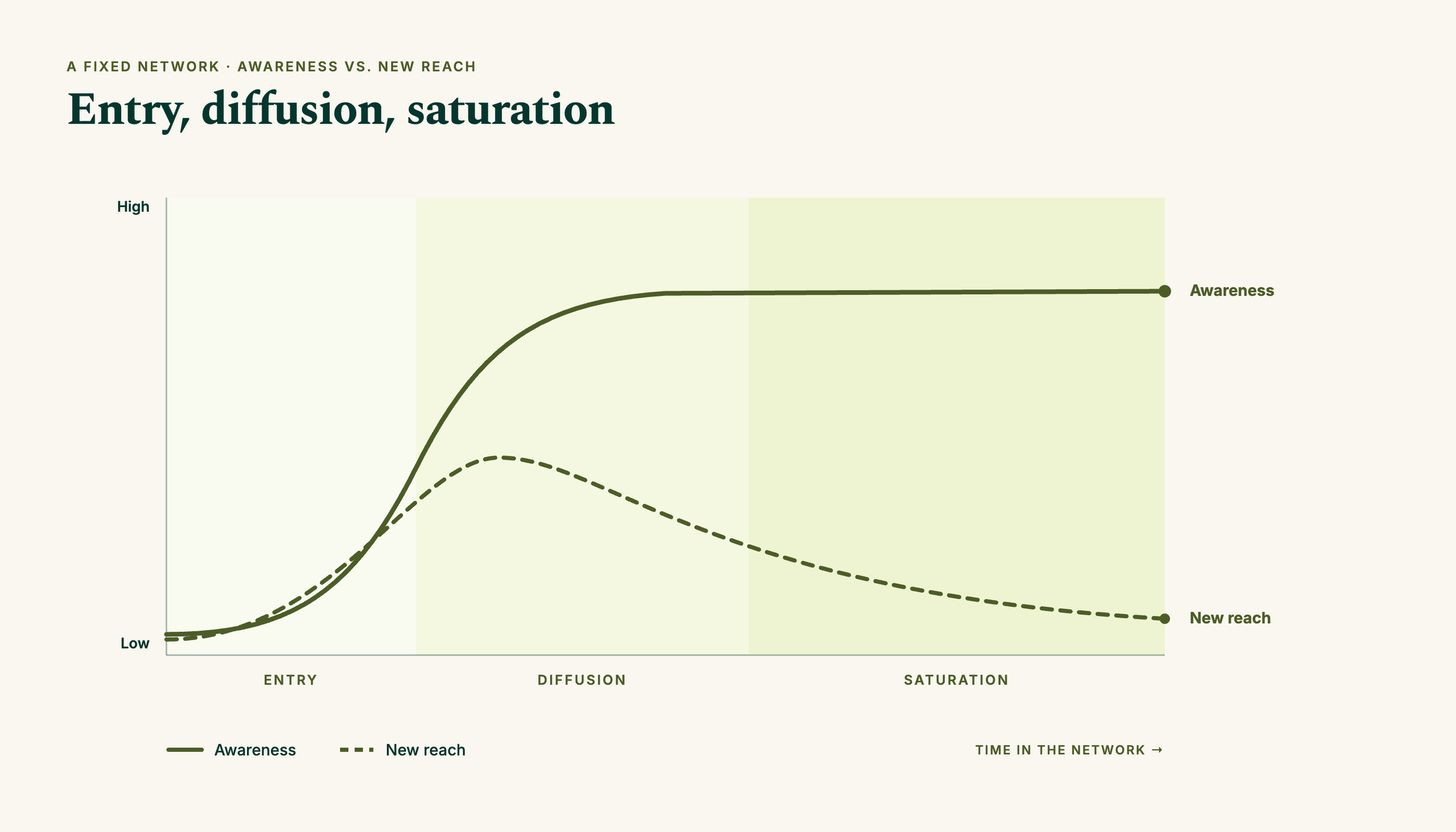
Networks tend to move through three phases: entry, diffusion, and saturation.
Entry. When you enter into a new network, you don't know a lot of people yet. There are many new people to meet, and you need time to get to know them.
Diffusion. At some point, you’ve built relationships with a few people. People hear you talk; they know what you do. Some people say, "I need to hire you." They tell others in the network about their results, and those people want to hire you too.
Soon it seems like you're everywhere, and people are saying, "You should get to know so-and-so. Their course was great, their program was great, their service was great."
Saturation. Eventually, especially in what we'll call a fixed network, you saturate it. People know who you are. You are seen as the go-to person there; you have an established reputation with high awareness.
You might be thinking, "But not everyone who could buy from me in that network has bought from me."
That's true. But there's a difference between awareness and new reach.
As you get to know people in a network and your reputation grows, awareness rises, and many new people can buy from you because they're hearing about you for the first time.
Once your reputation is established, if the network isn't growing, most of the people in it already know about you. Some of them have already purchased from you. Others have decided whether or not you're a fit for what they need.
There might still be some people who weren't ready to work with you when they first heard about you, so that network can continue to bring you clients over time.
But new reach declines.
The initial leap of clients, when suddenly you're everywhere and everyone's buying from you and enrolling in your courses, tapers off as you become established.
You can have an excellent reputation in a network and still have a declining source of new clients.
That is, unless you're in a growing network.
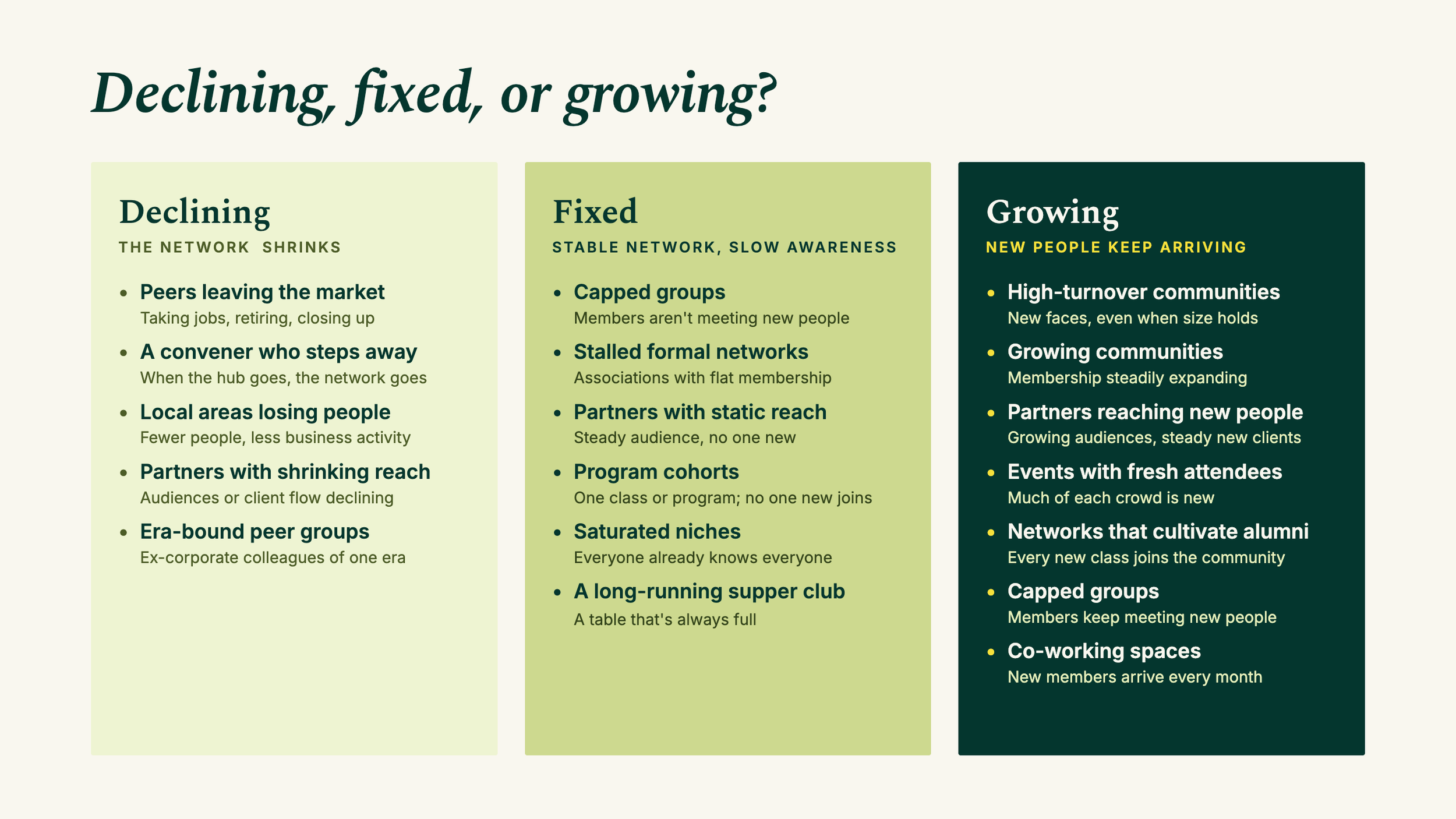
Networks evolve in three ways: declining, fixed, and growing.
Declining networks
Sometimes the network itself is shrinking.
You have a network of referral partners you've been keeping in touch with over 10 to 15 years. Sometimes those peers leave the market. They take jobs, they retire, they close up their businesses.
That's what happened to my local network. Of the cohort I started my business with, the one giving me referrals and introductions, all but one has gone back to corporate or left the online business space.
If they were my referral partners, not only is that network not growing, it's shrinking.
Other examples include:
A convener who steps away. Maybe a community you're in gets bought by someone new, and people leave. Or the person running it says, "I can't do this anymore," and shuts it down.
Partners with shrinking reach. They're still in business, but they have fewer clients, or their audiences are leaving because they've left the market or lost interest.
Era-bound peer groups. When I started my business, I got a lot of consulting work initially by working with a firm of ex-Nike people, because that was my background. It's now been 10 years since I've been at Nike, and a lot of the people I used to work with have retired. I've lost touch. I'm no longer particularly active in those groups.
In declining networks, you may be losing access to people even if your reputation hasn't changed.
Fixed networks
Fixed networks can be stable. But once you're in and established, there are few new people left to discover you.
Think about a few examples:
Capped groups. You’re in a networking pod of 8 people. Once you've met the 8 and you know their networks, those 8 members could be incredibly valuable. But if they're not meeting new people, they cannot bring you more referrals.
Stalled formal networks. You're in an association, but the membership is flat. Only a couple of new people join each month. When you started, maybe you got to meet 50 people right out of the gate and get to know all their networks. But now you're only meeting the 1 or 2 people who join every month.
Program cohorts. You did a cohort-based online writing cohort or a business-building program. But that was one round, and if that community hasn't done a very good job of connecting the cohorts, you're only going to meet those people once.
Social groups. In my first year of business, one of my referral sources was a book club. I worked with a couple of people in that book club, but there are no new people joining it.
Again, you can have a high reputation, but no new people are joining, and at some point you're going to run out of people who are hearing about you for the first time.
Some people in these networks may still buy from you, existing network members can refer, and they're wonderful for peer support. But once you've reached saturation, they may not be reliable sources of new clients.
Growing networks
In growing networks, new people keep arriving.
Growing communities. Maybe you're part of a membership that went from 20 people, to 40 people, to 100 people, and keeps growing. Especially if you're a long-standing member of that community, if the community is growing, your reach will grow.
Partners who are reaching new people. My podcast co-host and I are both creating content. My membership is currently capped, but I'm still getting to know new people and enrolling new clients. I'm consistently growing my audience, and I'm telling everybody about my co-host, Meg. So Meg has a partner who is reaching new people, and vice versa. We're growing our own audiences and therefore growing the pool of people we can refer to each other.
Networks that cultivate alumni. My Charlotte business school community has cross-class alumni networking opportunities. There are always new graduates coming in, and the schools actively cultivate relationships across classes.
Capped groups inside a growing network. A capped group can still grow if its members keep expanding their reach, like a small group of super connectors who are always meeting people. The group stays the same size, but its web keeps growing.
That last example is important.
A network doesn't necessarily need more members to give you access to more people. The people already in the network can be actively expanding their own relationships.
And the reverse is also true. You can belong to a large network that isn't introducing you to anyone new.
So for each network, ask: Is the network itself declining? Is it fixed? Is it growing?
Once you know what's happening to each network, you can start to see why you used to be getting referrals from these places and now you're not.
But it's not just about what one network does.
It's about what your entire network portfolio looks like.
Mapping Your Network Portfolio
What does my network portfolio look like, and what happens to it over time?
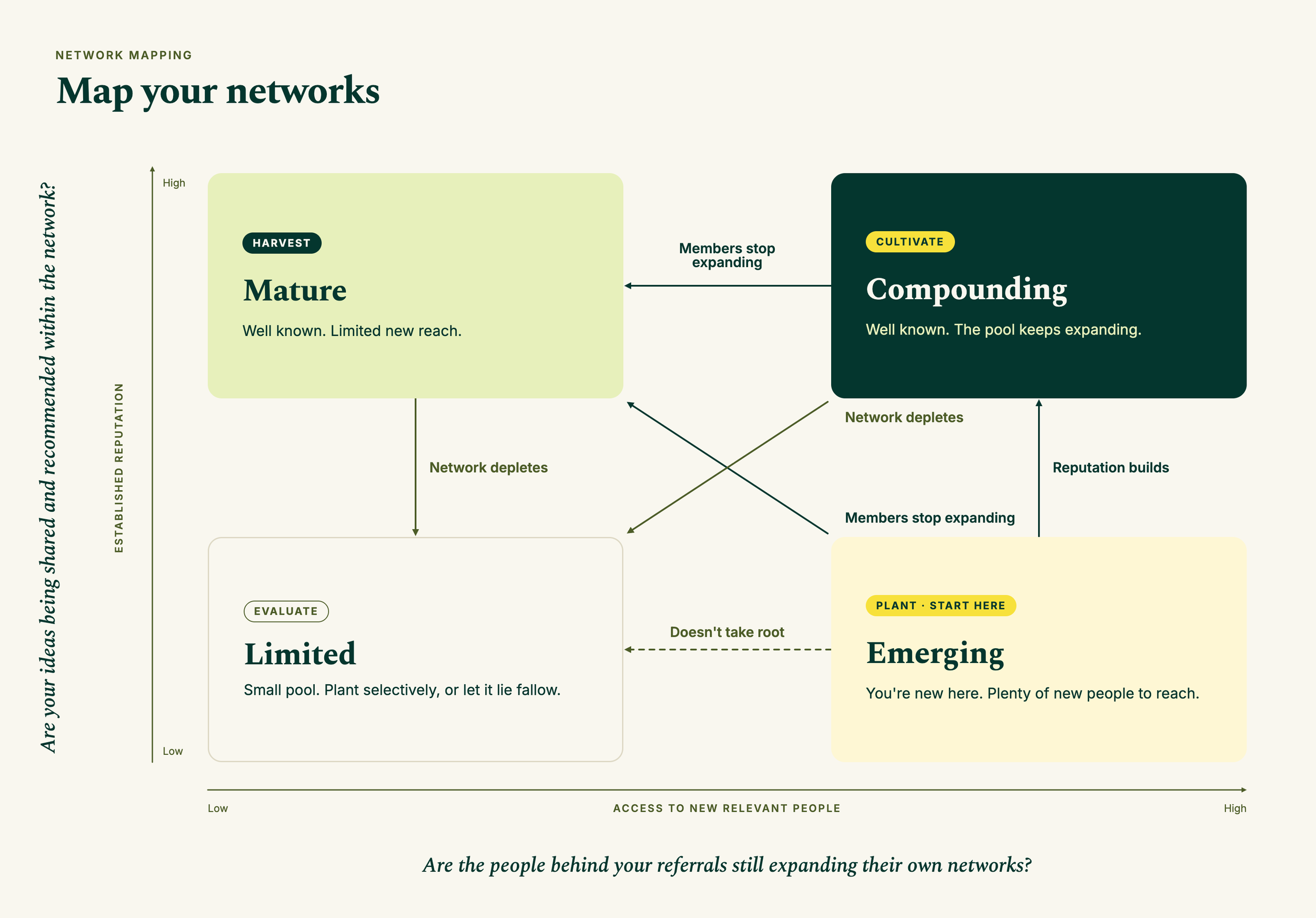
The map has two axes: access to new relevant people, from low to high, and established reputation, from low to high.
Emerging: where you start
When you enter a network with plenty of new relevant people to meet, you're emerging. You're new. People don't know who you are yet, so you don't have an established reputation.
You'll spend your time planting seeds and getting to know people: you have coffees or virual zooms, tell them what you do, hear what they're doing, and build a reputation over time.
Start pitching the moment you arrive, and people will kick you out real fast. Take the real time to build relationships that will serve you well into the future.
Compounding: the pool keeps expanding
As your reputation builds in a growing network, it becomes a compounding one: the pool keeps expanding along with your reputation.
Here, you cultivate relationships with the people you know and keep planting seeds with new ones: you answer questions, offer counsel, introduce yourself to new members, and make connections.
A compounding network can serve as a place to keep building relationships with trusted peers. And if your clients are in this network, it can also be a continued source of new client growth.
Mature: well known, limited new reach
But if the network is fixed, establishing your reputation doesn't take you to compounding.
It takes you to mature: the harvest stage.
You are well known. You are well respected. You might have amazing peer support. But that network may no longer be giving you new clients if there's limited new reach.
There are plenty of reasons to be in networks that have nothing to do with client acquisition.
I'm in several networks where so few new people join that I won't get clients from them. But they're there as peer support. They're who I rely on. I'm seen as a trusted expert in those networks.
But if I had been counting on those networks for clients, I'd feel it in my pocketbook 6 to 12 months later.
Limited: limited access to relevant new people
Limited doesn't mean the relationships aren't valuable. It means the network offers limited opportunities to expand your reputation or reach new people.
Sometimes you joined a network and thought, "Not for me. I don't really think this is the right place."
You never invest time in getting to know people, so it never takes root. You never become an established presence there, so you go right from emerging to limited.
A mature network you're harvesting can also deplete. Maybe it was a fixed network and you've grown out of it. Or the people you were closest with started stepping away, because they've also decided it's not a network they need to be investing in.
At some point, a mature network can drift to the point where you don't really know the people in it anymore.
That's what happened with my Nike network. For a while, I knew a ton of people and I was very well known. But now I don't know a lot of people. So my reputation is down, I'm not meeting new people, and it's an opportunity to ask, "Do I still invest here?"
Now, there are some networks where you say, "These are the most valuable people I know. These are the most valuable relationships I have. I don't care if I can't invest in it on a regular basis."
But if all your networks are mature or limited at the same time, your client acquisition will feel it.
You may be well supported. These may be your best friends. But if you rely on your networks to spread your reputation and bring in clients, you can't live only on the mature and limited side of the network chart.
Develop Networks Before You Need Them
You can't wait until your existing networks stop generating clients to start building relationships somewhere new.
In the entry phase, people don't know who you are or when to call you. They just see another name on the conference registration list, or another new entry.
Pitch too soon, or talk about what you do too much right out of the gate, and the network rejects the transplant.
We need to consider building a network portfolio like farming different plots of land.
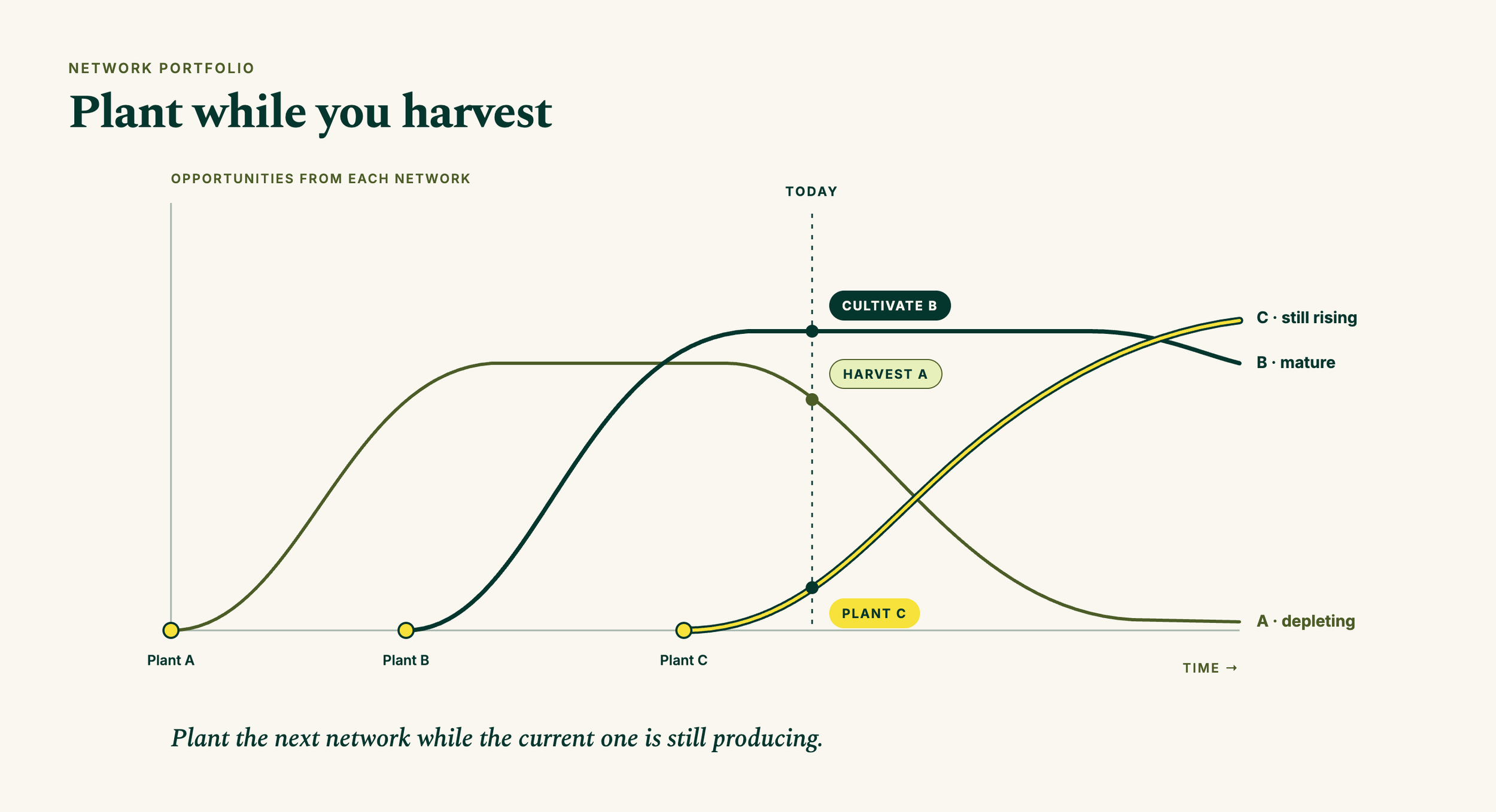
Planting. You’re planting new seeds, putting a high level of effort on getting to know new people in new networks. This takes time, presence and focus.
Cultivating. In the cultivating networks, you’re spending time in still incredibly productive, fertile territory to keep building your reputation, meeting new people, and serving those in the network well.
Harvesting. With mature networks in the harvesting phase, you may spend less time building new relationships but still participate and add your expertise as time allows. You’ve still built a reputation and members will know when to call you.
Stepping back. And that plot over represents networks you used to be part of. You still love those people, but as it no longer generates clients you’ll sunset your active involvement.
It sounds transactional, but there are only so many places and opportunities for you to give your time, your attention, your resources and your money.
Maybe you don't come to as many of the calls or events in a mature network, because you've got to spend your time somewhere else: you're actively planting a new network.
Sometimes you have to say, "This network served me well, and I need to step back from being involved. I need to make sure I'm giving enough attention to planting new networks, staying actively present in the ones I'm cultivating, and maintaining relationships with the ones I'm harvesting.”
And remember, you can't just be in a network. You have to actively be building your presence there.
Think about a co-working space. New people might arrive every month. But if you just go to your office, work quietly and leave, and you don't engage in the social activities or the member events, you're not going to experience it as a growing network.
Access to new people only matters if you're actually getting to know them.
Evaluate your Portfolio
Look at the networks you're part of: not just the formal networks, but the informal networks you've been part of this year and that you'll be part of next year.
Which networks are you planting in, where you're still building your reputation?
Which are you cultivating, where you're already seen as an established voice but you're still actively getting to know new people?
Which networks are maturing, where you need to ask, "What's my involvement going to be here?"
And which are the networks where you say, "This was an amazing group of people that I will cherish. They'll be on my once-a-year Christmas card list. I'll come to the annual gala, but I'm not coming to the monthly board meetings anymore"?
So ask yourself:
What does my portfolio look like?
Am I investing enough in new networks?
Am I over-investing in networks that serve a different purpose in my life for the next year?
And what does that tell me about my strategy for the next year?
Because if your client acquisition depends on relationships, you can't rely exclusively on the networks where you've already built your reputation.
You need to develop networks before you need them.