

The Rise and Fall of Courses and Cohort-Based Programs
Courses and Cohort-based programs had their boom in 2020, 2021 and 2022. Then a lot of them seemed to take a downturn.
Was the problem the economy… or economics?
What founders think kills a cohort program usually isn't what kills it.
There are five curves behind the rise (and sometimes fall) of these programs.
Curve 1: Audience growth
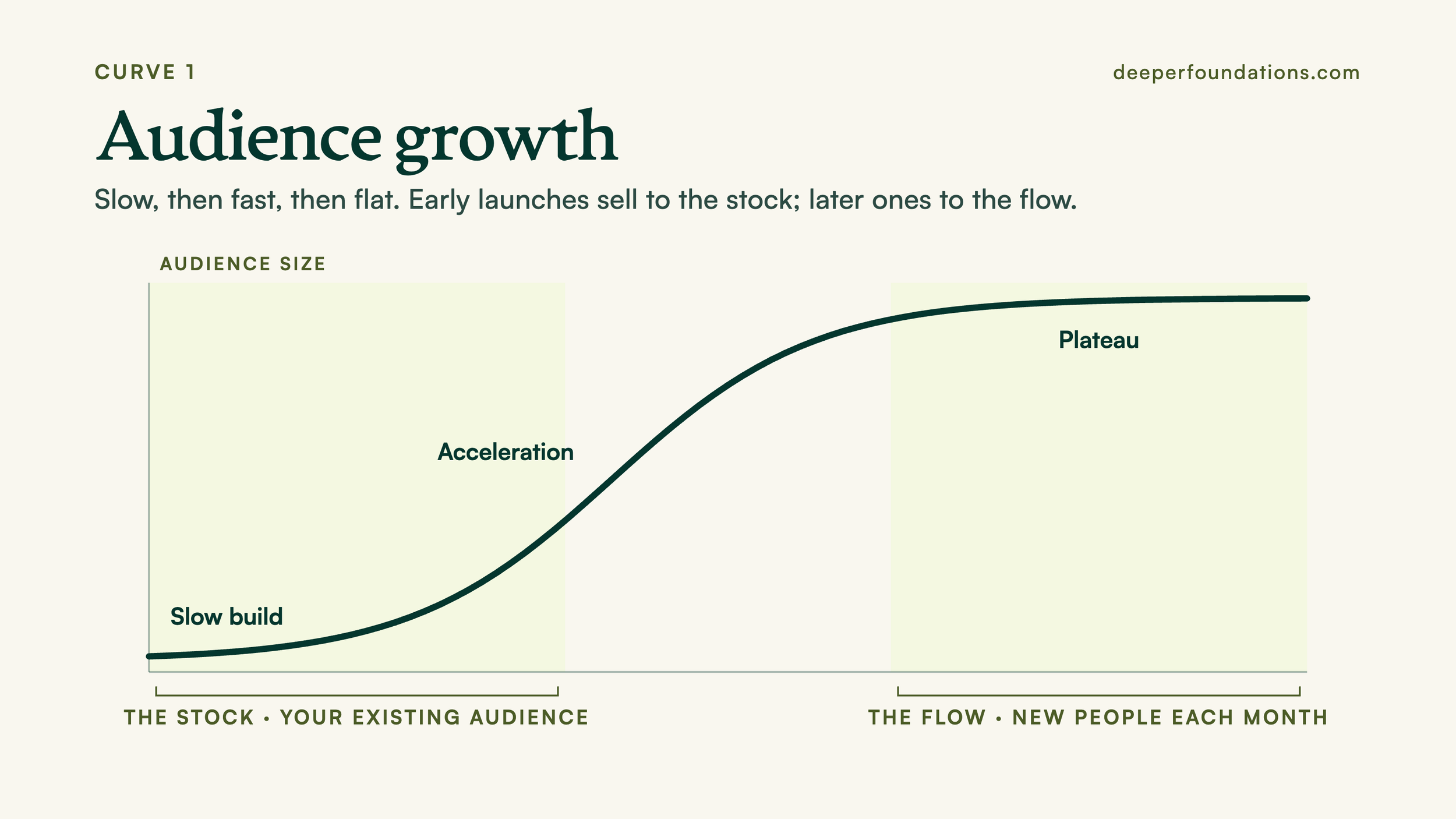
When you start a business, your audience grows slowly. You build relationships, get your work in front of people, participate in social networks. Then, sometime after your first cohort or two, your followers' second- and third-degree connections start hearing about you, and growth accelerates. The curve looks a bit like an S.
At some point, growth tapers off. This is normal. You hit the natural limit of who's going to hear about you.
Part of the reason is that early acceleration often comes not from who you know, but from market and platform arbitrage. You happened to be on Twitter right when threads took off. You were on LinkedIn before the oversaturation of hooks. You were on Facebook while ad traffic was cheap.
And sometimes the platform stops working on your behalf. Maybe you were on search and AI tanked the traffic, or you were on X when everyone left, or on LinkedIn once it filled up with slop, or on Substack when the discovery algorithm changed. If your growth was tied to that platform, your curve flattens. However, if you established yourself on a couple of platforms that kept working (or built a team that helps), you may keep growing and reach escape velocity.
Stock vs. flow
When your first few cohorts sell out, you're tapping into your initial audience: the stock. These are the people who heard about you first: super fans with years of latent demand. As growth accelerates, you start reaching people one or two degrees away from your existing network.
How much you capture from those second- and third-degree connections depends on how big your audience was when you launched.
With an audience of five or six hundred, your first cohort might go really well, but there aren't many people in their networks. That's why you might see a drop-off in the second or third cohort.
With a bigger audience, there's more word of mouth, more FOMO from people who didn't get in early, and a second wave of registrants.
The stock is the accumulated goodwill from the years you spent building an audience and a reputation before you launched. People may not trust you yet, but they trust the friend who got results.
Once you've launched the same course to them a few times, though, the size of your audience matters less than how many new people you add each month. That's the flow. Say someone grew their list to 30,000 people before launching. After the stock is exhausted, they aren't marketing to 30,000 people anymore. They're marketing to the handful who joined each month since.
Curve 2: Capture rate
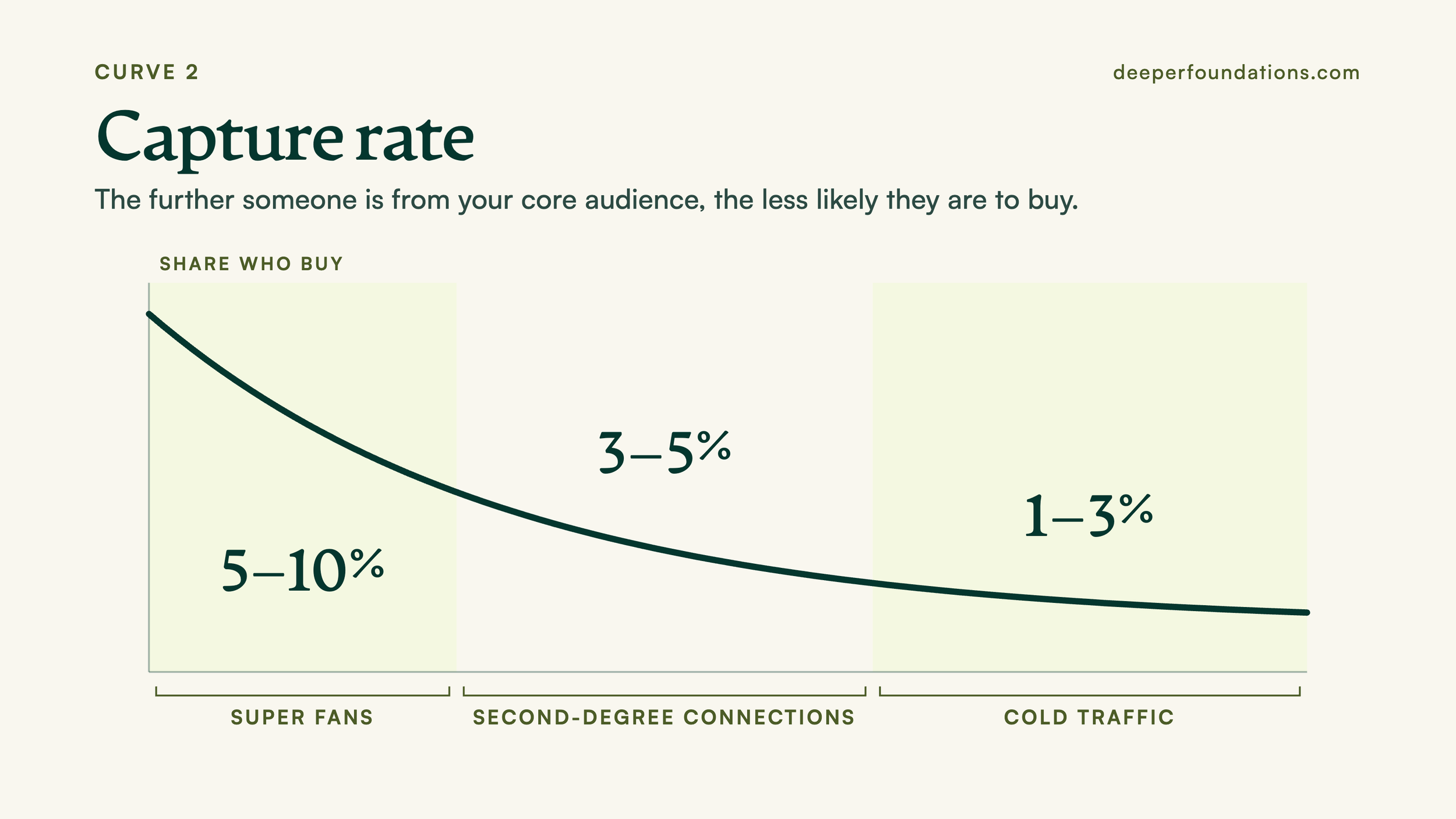
Your initial stock (your biggest fans) has the highest capture rate. Over a product's lifetime, you'd be lucky to get 5 to 10% of them to buy. They have years of embedded trust.
Second-degree connections convert lower, maybe 3 to 5%. They saw a friend get results, there's momentum… but they don't trust you the way someone who's followed you for years does.
Cold traffic converts at 1 to 3% at best. And that's for really good marketers. It can go a lot lower. These numbers come from my experience with smaller audiences and may be overstated, but the physics hold.
Curve 3: Program effectiveness
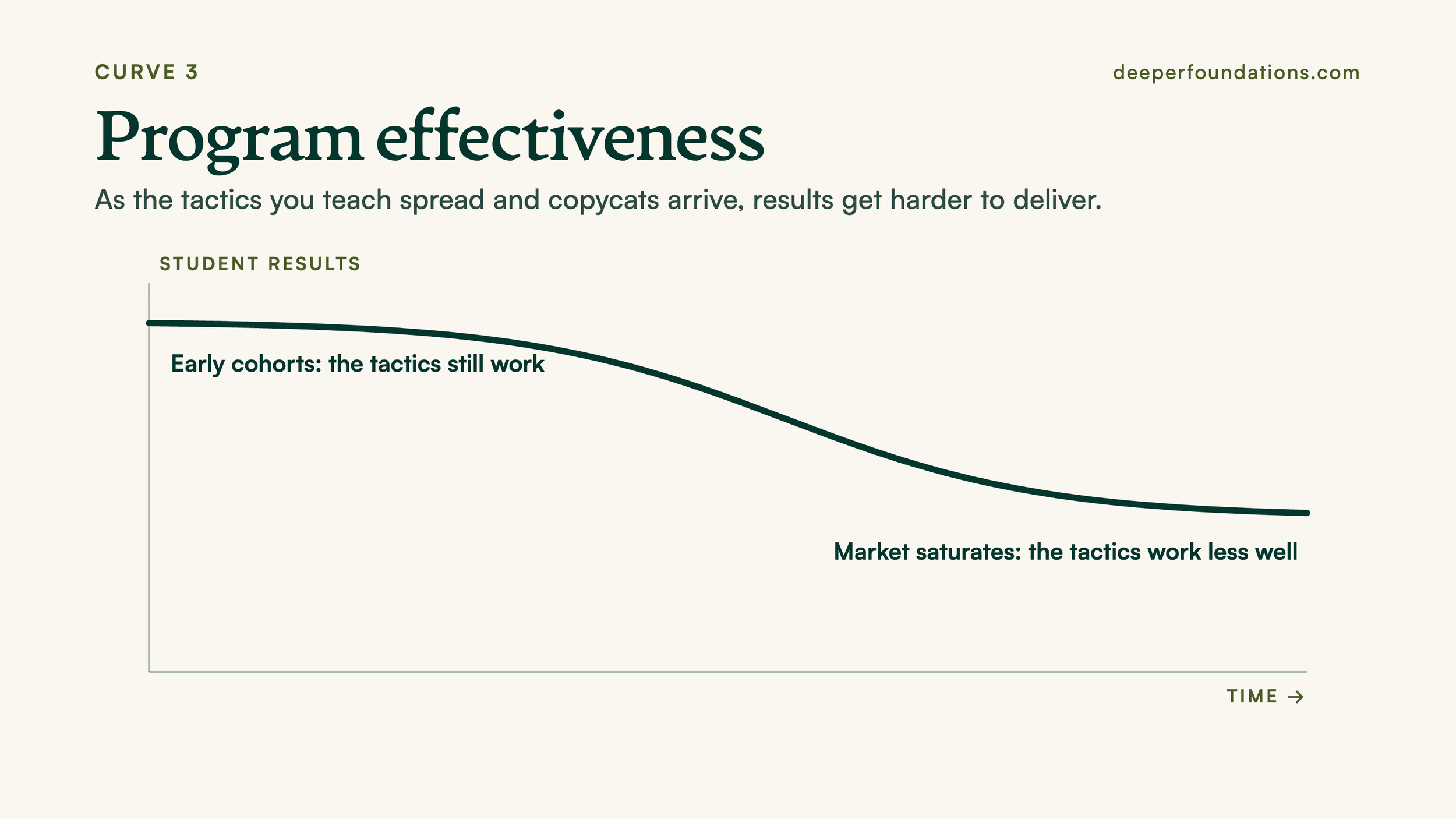
Meanwhile, your program may be getting less effective.
If you taught LinkedIn growth before everyone saturated the market, your early cohorts had an easier time getting results. Later cohorts maybe didn't. As more competitors enter and the tactics you teach become widespread, those tactics work less well.
So you're going out to colder audiences, facing more competition, and possibly selling something that delivers less than it used to.
I don't know about you, but I'm tired of watching Yap challenge videos on Instagram. There will be copycats selling their own programs. The bigger the program gets, the less likely the strategy produces the results the early people got.
Curve 4: Cohort size
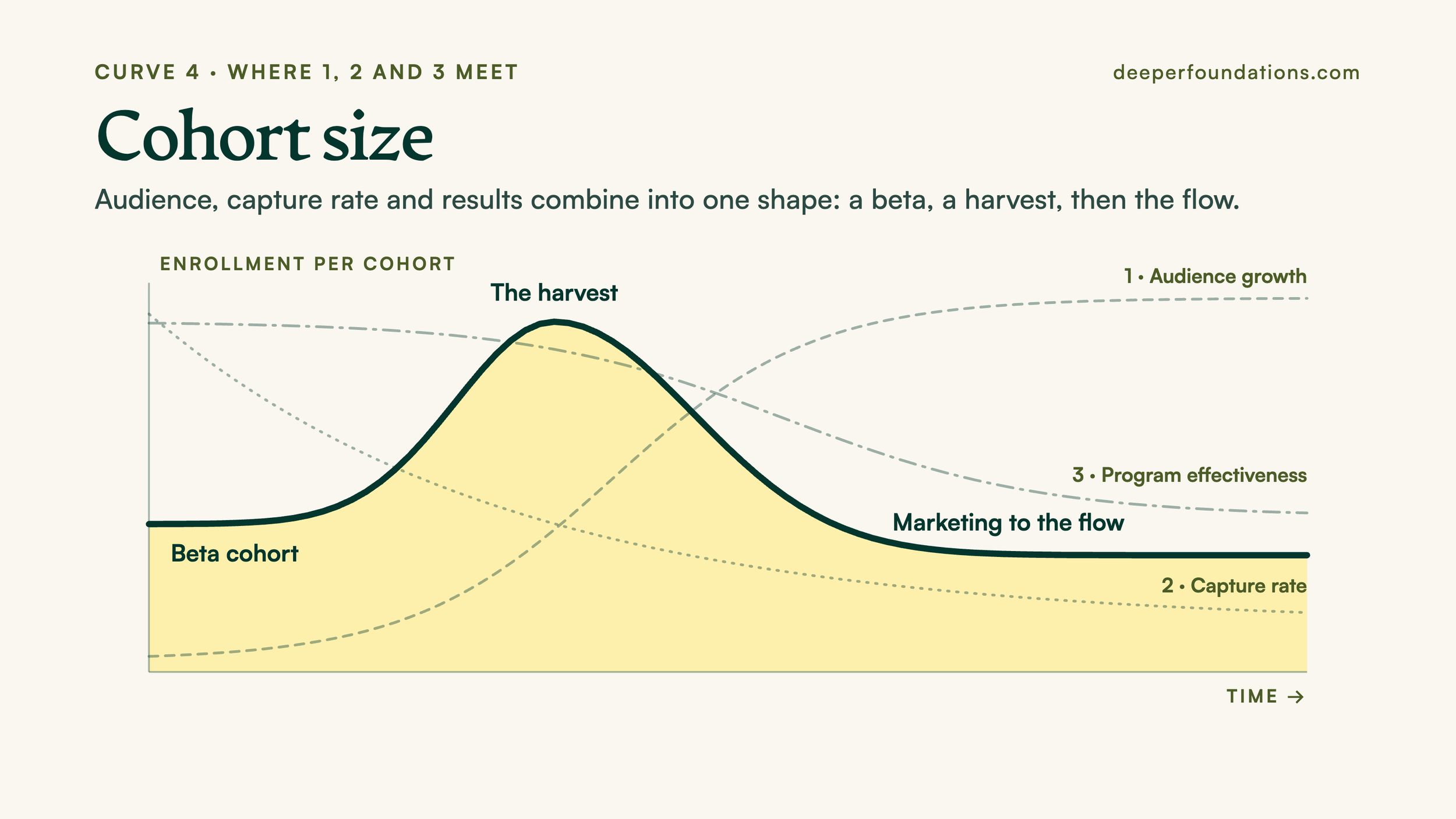
Put the first three curves together: your first cohort or two is a smaller beta round filled with your best fans. They get great results because they've been following your work and came in prepared. Then cohorts get bigger. Your audience accelerates as people post about their results, and you reach second- and third-degree connections. Sometimes the results of the follow on cohorts aren’t as impressive.
Then you hit a threshold. Most of the people in your audience have seen your offer a couple of times. They know whether it's for them.
Sometimes we sell harder, with bigger bonuses and fast-action discounts, to keep the numbers rising. But eventually you're marketing to the flow, at a 1 to 3% capture rate, while the tactics and the marketplace saturate.
Cohort size goes down. You've captured the harvest.
On its own, that's not a problem. Take the harvest from your initial stock, put it in the bank, and know the day will come when your audience stops growing and your cohorts get smaller.
Mitigating the downturn: follow-on cohorts
This is where a lot of cohort businesses add a second curve. The original program launches, then comes an extension, a second program, a mastermind or a membership. One popular online writing program launched a viral 30-day challenge, followed it with a longer program on writing online, then one on becoming a professional writer online.
Each follow-on program has its own rise and fall. Stacked together, the curves can smooth out. Total enrollment across the company may stay relatively stable even as any single cohort shrinks.
What doesn't necessarily stay stable is the complexity. One program becomes three or four, and each one has to be launched and delivered. Revenue may hold steady while the operation underneath it gets more complicated with every product you add.
Curve 5: Expenses
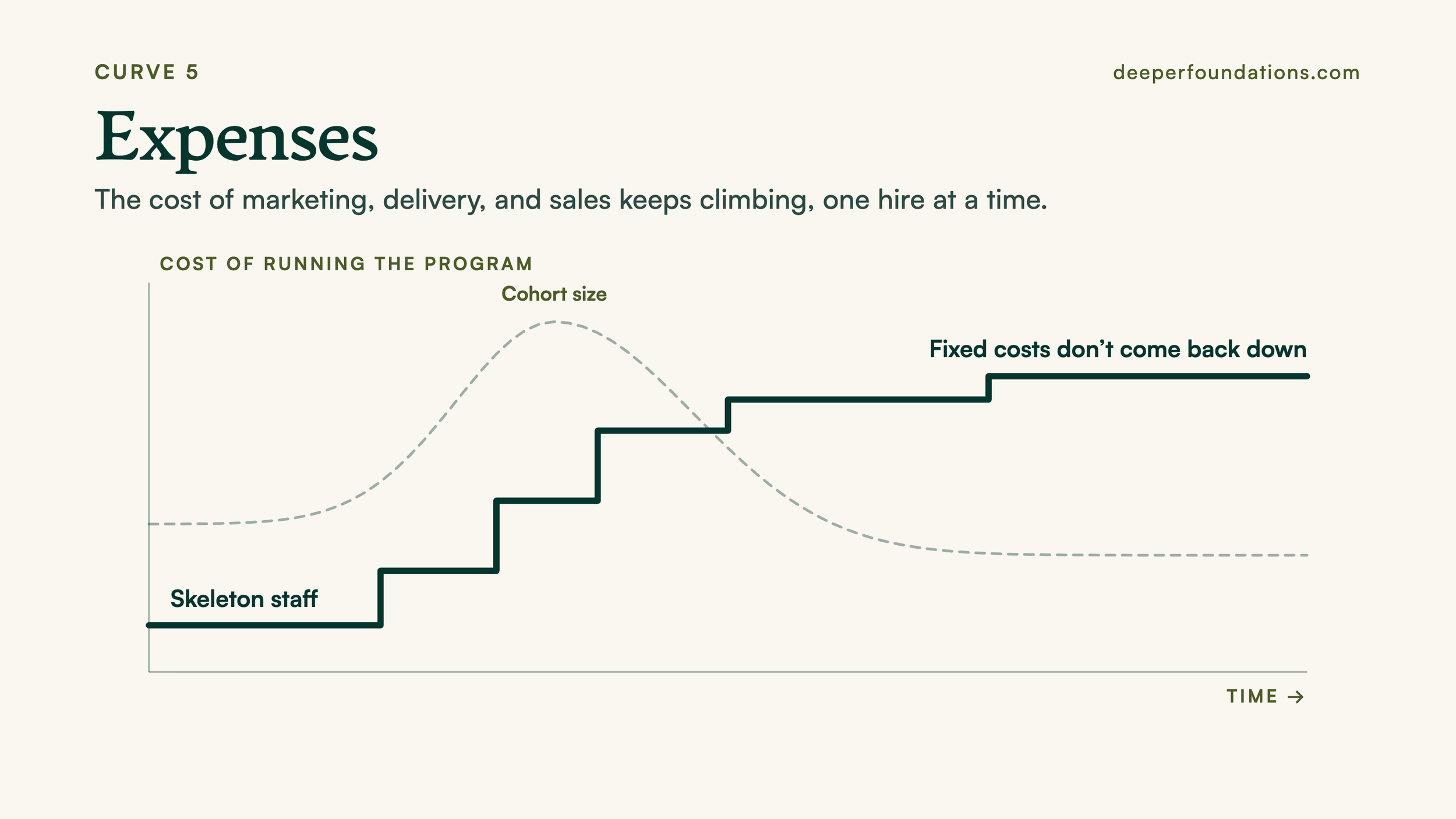
When you're starting out, it's you and a skeleton staff.
But, as the cohorts grow, so do your expenses.
More people want in, so you add a community manager, a cohort manager, an assistant, and support coaches because we're told to stay in our zone of genius and standardize delivery.
And as you grow, you want to capitalize on momentum. You invest in a content team, copywriters, launch staff, affiliates, and a sales team with setters and sellers.
So cohort size rises and falls while the cost of delivery keeps climbing. Add follow-on programs and it can climb faster, because every new product brings more people to run it.
When expenses outpace demand
Declining cohort sizes get blamed for a lot. But enrollment falling after the harvest is expected, and a smaller cohort on its own doesn't sink a business.
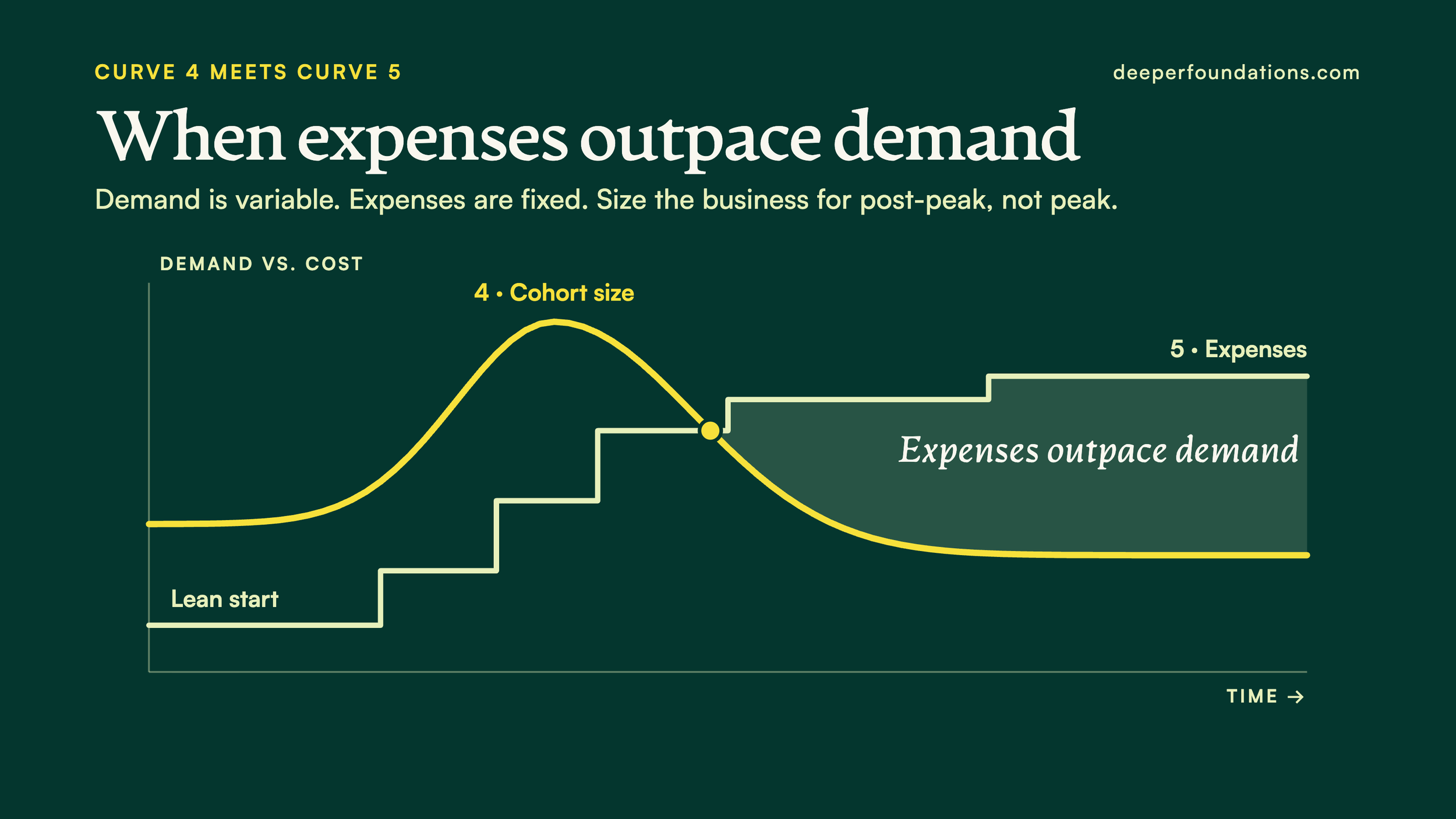
The problem comes when the cost of the operation outpaces the revenue.
Cohort size is variable demand, known only in retrospect, and expenses are often fixed and either laid out or committed in advance. You've paid for the ads up front. You've hired the team. And people are harder to cut, because they're humans who rely on you for work.
Size the business (and expenses) for the peak, and when enrollment comes back down you end up in a topsy-turvy situation where the cost of running the program no longer makes sense with the economics of it.
That's when you see people selling harder, marketing harder, and pulling demand forward to hold on to their team. That's understandable. The rise and fall of cohort enrollment is manageable until the expenses of running the business outpace the demand supporting it.
How to prevent the rise and fall of your programs?
Option 1 is to get exceptional at marketing, and continue outrunning the cost of your programs with really good paid strategy, killer copywriting, and illustrating phenomenal student results.
But let’s say that’s not how we want to spend our time. (Except the outstanding results. Go get those).
Alternatively, we can know this trajectory is coming and anticipate it.
Limit cohort sizes. Instead of capturing all the demand up front, cap it. Yes, you're turning away money. You're also creating scarcity for the next round.
Treat the peak as bounty. Sell a little less hard, accept a smaller cohort, and don't staff up your organization to handle a blip.
Size for post-peak. The acceleration won't last forever, so ask what your organic growth rate looks like after it. How many people are you adding each month? How often do you launch?
Size your fixed costs (marketing, admin, selling) for post-peak, not peak. When a cohort comes in bigger than expected, do a little more founder magic. It's a short-term cost, not a reason to hire.
Does that leave money on the table? Maybe. Does it keep you profitable even if you do? Yes.
That's why my high-touch cohorts are capped at 20. Audience growth in my business is pretty linear: a few hundred new subscribers every six months, with a couple of peaks. It has never grown exponentially.
Depending on how many new subscribers I add and the capture rate, I might expect roughly 10 to 12 new seats per launch, with launches every six months. Add five to seven returning buyers, upgrades or alumni, and the cohort is about 15-20.
Each launch starts with the same questions: What's the average run-rate growth? Is this an acceleration period? Will it continue? If not, size for standard organic growth instead of assuming the acceleration will last.
It's about growth rate, not audience size.
So get curious. How many new audience members have you added in the past few months? If you captured only 1 to 3% of that new growth (not your existing audience), how would you size your cohort? Has your growth rate slowed even as your total audience stayed large? And how would you right-size your expenses to match?
You won't always get the bounty of the harvest. The goal isn't the most revenue possible. It's to be as profitable as you can so you stay in the game.
Is it the economy or economics? You make the call.