The Craftsman Debate: Intensives vs. Retainers?
let's dive into our first Expertise Path: variations on the Craftsman model.
In the Craftsman model — a Delivery-based business — you deliver a service, and a big chunk of your week is spent doing the work, not just marketing it. You love the craft of doing. Think bookkeeping and tax prep, ghostwriting, copywriting, graphic design, video editing, virtual assisting and online business management, web design, or delivery-focused Fractional services where you’re acting as part of your client’s team rather than simply advising them. If you’ve ever called yourself a freelancer, you’re probably running a Craftsman model.
There are two camps who insist their model is the way to scale a business like this.
One camp says “Intensives are the only way to scale solo.”
The other says “You can’t grow a freelance business without recurring revenue.”
Intensives, my example of short-term productized services, show up under a lot of names: VIP Days, website-in-a-week, brand or finance intensives. For deliverable-based businesses they usually last anywhere from a day to a month, while advisory work sometimes stretches into a two-month sprint.
Long-term work usually takes the form of retainers, maintenance/subscription packages, or ongoing advisory.
For the Craftsman, this isn’t just a pricing decision.
The choice to build your business around short-term productized services or long-term recurring revenue determines all of your structural foundations: the marketing engine you’ll have to build, the central focus of your authority, how you’ll protect margin, the rhythm of your year, and the kind of relationships you’ll have with clients.
Before comparing them, it’s worth recognizing that this choice is downstream of two things — the kind of work you do and the price your market will support.
Some services naturally end when the deliverable is complete. Website design, brand creation, and messaging development are good examples. (Though, there are often options to continue adding value post-deliverable should that be in your wheelhouse, which we’ll talk about at the end).
Pricing matters just as much.
An intensive has to generate substantially more revenue per hour of delivery because you’re absorbing all of your marketing costs and pipeline risk into a small number of sales. A $10,000 intensive every month is a fundamentally different business from five $2,000 retainers, even if the annual revenue is identical.
A lot of people choose intensives because they sound freeing, then underprice them.
So before you pick a side, ask yourself one question:
Can I command a price that makes intensives work with the number of clients I can realistically sell in each year?
With that, let’s get into the ‘battle royale’ between intensives and retainers!
In one corner: Intensives!
The promise
Intensives work because alignment happens before you start, often with some sort of lead/gateway product process to both sell in the work and get that alignment.
The client has to hand over assets in advance, calls are booked before the project begins, revisions are limited, and the scope stays firm because there’s no time for it to deviate. Every service provider has been burned by a project that changed direction halfway through or dragged out before completion, and intensives only work because the process structurally prevents that from happening.
By collapsing the timeframe, you eliminate much of the scope creep and admin work that accumulates on longer projects. And if you only take on one project at a time, you avoid the constant context switching—you get deep into the flow of work for one client until it’s done, instead of bouncing between five.
Because the work has a defined endpoint, intensives also give you genuine schedule flexibility.
Want to take the summer off? Frontload your selling and scheduling. Need breaks between projects? Schedule only 1-2 intensives per month.
Delivered in a tight timeframe and priced appropriately, the intensive structure also frees up time between projects for marketing. Instead of protecting a few hours every week for relationships and marketing, you can run “on” weeks for delivery and “off” weeks for business building.
But the promise comes with the perils
An intensive business needs a constant supply of new clients.
Say you need one new client per month to make the money you need. Sounds reasonable — that’s 12 clients a year.
But if your service isn’t repeatable, that’s 12 in year one. And 12 in year two. And 12 in year three. That’s… a lot of clients.
An intensive business doesn’t just require more clients. It requires a network that keeps regenerating itself. If most people only buy once, your authority has to continuously reach people who haven’t worked with you before. That’s why referrals, speaking, SEO, partnerships, and visibility become so much more important.
You also can’t price as if you’ll be fully booked all the time. Especially with deliverable-based work, there’s often a gap where your availability doesn’t line up with a client’s timing (or vice versa). If your pricing assumes perfect utilization, those gaps quickly impact your total revenue.
And all of this only works if you keep scope locked down with a tight process — because the goal is to protect 50% of your time for the marketing that brings in all those new clients. Hunt for every place scope creep or execution leaks in. In operations, we call this poka-yoke: building quality into the process itself, so defects are never created or passed along (avoiding unplanned rounds of revisions at the end).
Your authority needs to reinforce both your positioning and your process. Often you’ll screen clients not just on fit for the work, but fit for how you work. If they can’t commit to how you run projects, how and when they submit feedback, what the process requires of them — they’re not a fit. And internally, because of the number of new clients you have, you need rock-solid onboarding and delivery tools.
This might sound like a dream. Or, having to get that many new clients sounds like a nightmare.
In the other corner: Retainers!
If intensives optimize for efficiency, retainers optimize for continuity.
The promise with retainers: never start the month from zero, because revenue is baked in. (Retainers, maintenance packages, monthly recurring revenue: same idea.)
Once you’ve ramped up your roster, you’re not replacing clients every month. Room for 3-5 ongoing clients? Once you have those five, it’s a matter of replacing one when it rolls off.
In terms of marketing, retainers run on a different structure entirely than intensives. You’re not selling a few times per month — you’re onboarding a smaller number of clients every year into a longer-term commitment. The sales motion is often slower, warmer, and more relationship-heavy. Using a lead product, strategy project, or initial promise is a great entry point, either bundled into the retainer price or sold as a separate project (and each approach has it’s pros and cons).
Much of the work is repeatable and predictable — which is good, because your delivery load can grow fairly substantial. Many retainers are an ongoing service: podcast production, copywriting or email management, bookkeeping, being an OBM or Integrator. Of course, the holy grail of recurring revenue is a service that doesn’t rely on producing deliverables every month — bookkeeping oversight, a website maintenance package, retained access for questions. In those cases, every client you add doesn’t automatically cost you more hours.
But retainers have perils too.
The first is at the core: to justify a recurring charge, you need recurring value. I’ve seen retainers or memberships where most of the value lands in the first 30-90 days in what’s really a project, but the ongoing fee stays the same. Over time, the increasing gap between the new charge and the new value created curdles into resentment on the client’s side.
The strongest retainers don’t simply continue delivering work. They create a roadmap to show what’s next, why it matters, and why there’s continued value to be created while working together. The roadmap becomes just as valuable as the work itself because every month continues to unlock value.
Second, if you’re delivering services, your delivery load climbs with every client. Eventually you max out capacity, and it gets very hard to protect time for marketing, sales, and business building when you’re always delivering. Without clear systems, boundaries scoped in, and appropriate pricing, retainers have a way of filling every available hour.
Third, taking time off gets complicated. To step away, you either batch deliverables to get ahead, plan for catch-up, or find coverage. And because you can’t always predict exactly when a new long-term client will arrive, it’s just as important to price assuming some gaps between clients as it is with intensives.
Fourth, and less talked about: you have to actually want to do the same or similar work, over and over, for the same clients. Recurring work can start to feel like being an employee — the standing meetings, the sense that you’re on call, conversations that repeat themselves. Some people are wired for that steadiness and have systems that make it efficient. Other people start to resent the work over time.
Is there a best of both worlds option?
Some providers split the difference. An upfront productized service styled as an intensive, with a recurring extension offer. Or have a few recurring retainers, with the occasional project mixed in.
It’s not fully the best of both worlds; you take on the context switching of retainers, but you’re also not grasping for cash every single month.
Others build in recurring intensives: a batched day of podcast recording and production instead of a weekly cadence, or a quarterly “website in a day” refresh. You get the admin savings of the intensive without the crush of new clients every month.
Ultimately, neither model is inherently better.
They’re simply solving different business problems.
One optimizes for focused execution and flexibility. The other optimizes for continuity and depth of relationship.
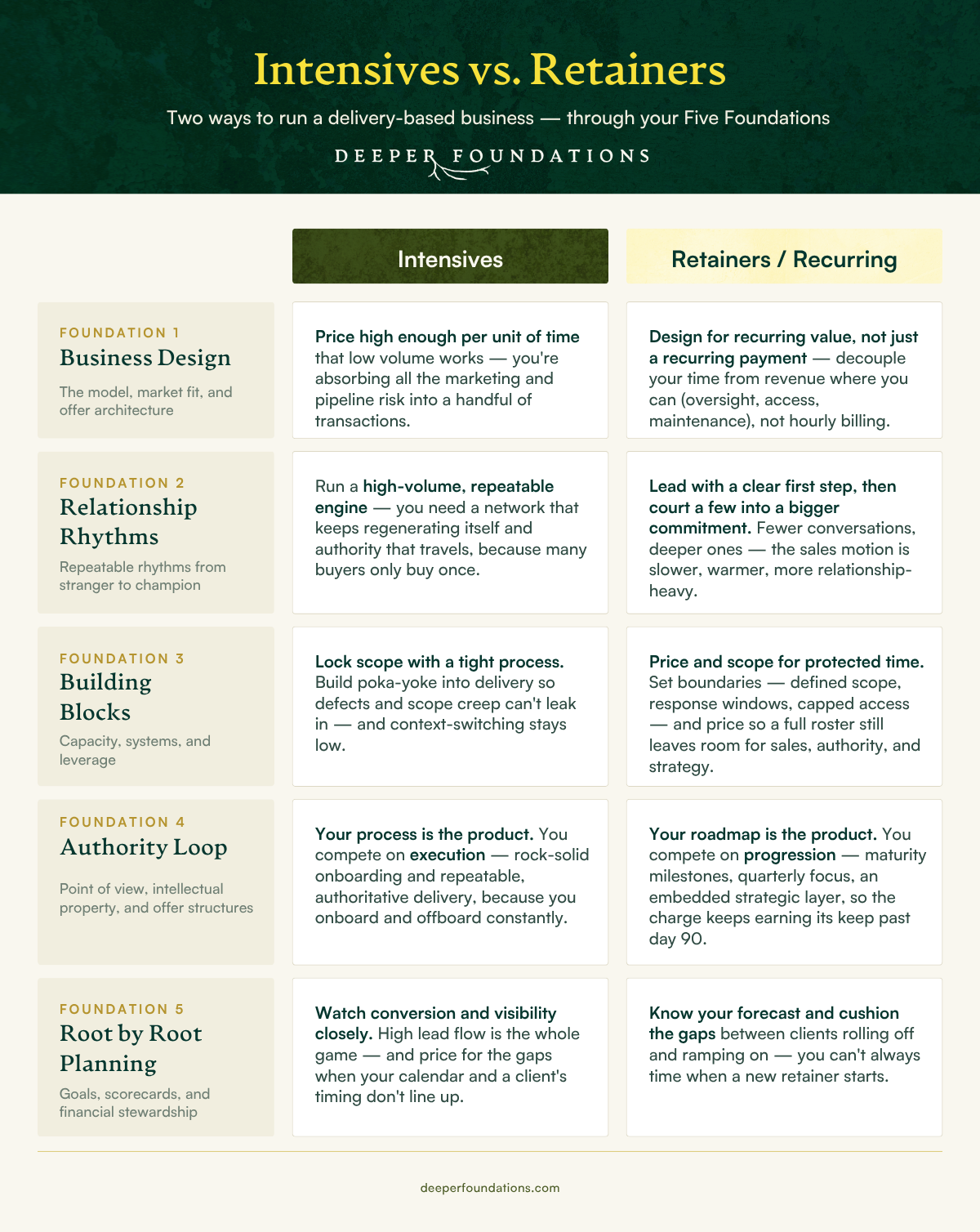
Whichever way you lean — intensive, retainer, or a blend — here’s how the choice shows up across your Five Foundations.
What does this mean for your Five Foundations?
Check out this handy reference guide!