

The Five Foundations across every Expertise Path
Welcome to the Expertise Paths: the possibilities of how to grow your expertise business once you’re somewhat established.
Each path has different sales and marketing requirements, operational demands, and priorities for what to build next.
But every path shares the same underlying foundations.
Before we explore the paths themselves, let’s establish those Five Foundations.
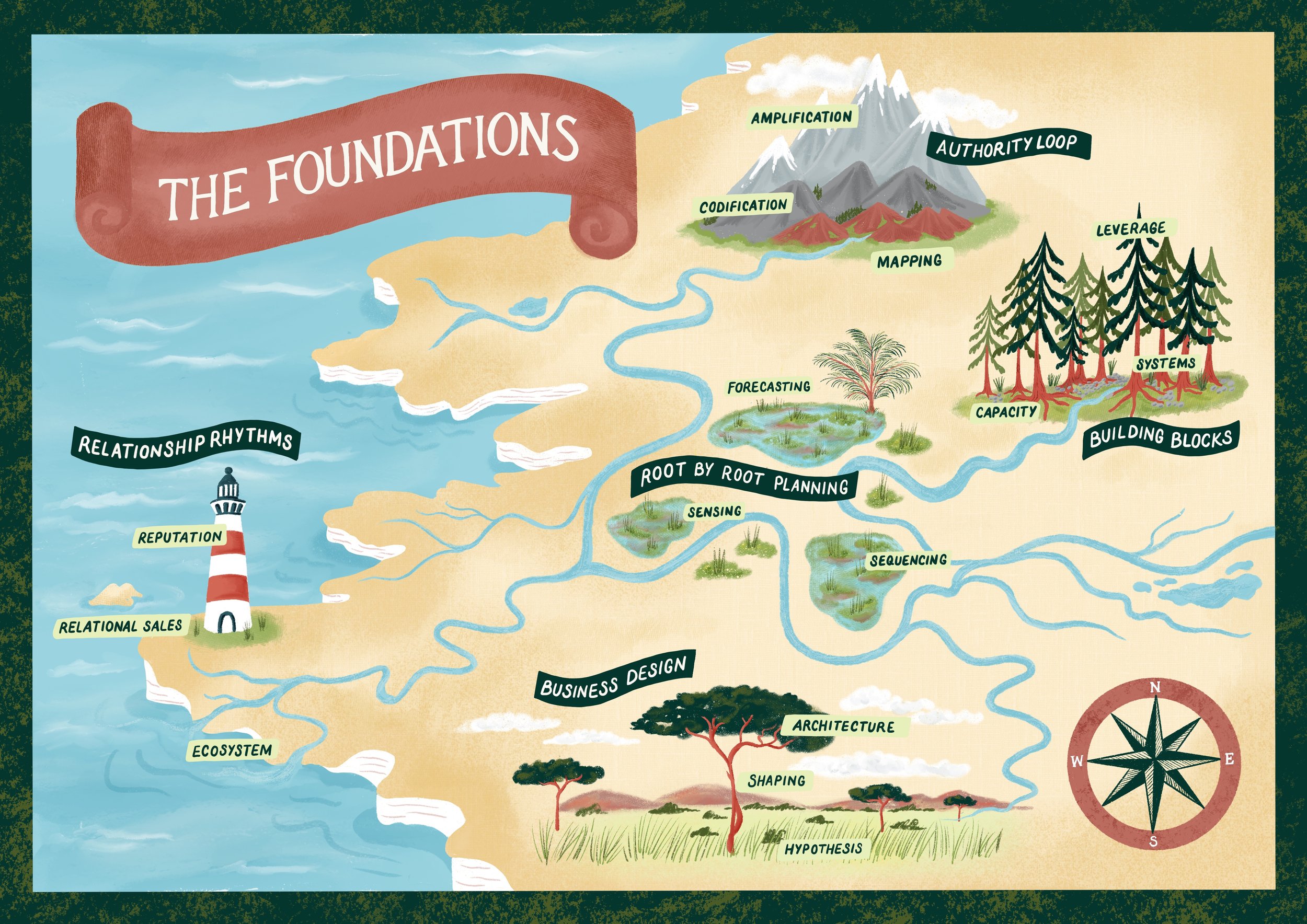
Foundation 1: Business Design
Everything starts with Business Design because it’s where you decide what business you’re actually building — based on your stage, your goals, and the life you’re trying to create. The other four foundations are about building that business well.
Your Business Model: who and how you serve.
Your Stage of Business: where you are and what deserves your attention now.
Your Goals, Vision, and Circumstances: what you’re optimizing for in this season.
Resilience: how you build a business that’s sustainable for you over time.
Your Expertise Path is ultimately a Business Design decision. Once you decide what kind of business you’re building, the marketing, operations, authority, and planning practices that make sense become much clearer.
Foundation 2: Relationship Rhythms
Relationship Rhythms is the domain of relational sales and marketing.
While many preach the gospel of social media and paid acquisition, the foundational marketing of every expert path is built on relationships. Your clients, referrals, and reputation all come from relationships.
The good news? The prescription is clear. The bad news? The hard part is actually talking to — and selling to — humans. Even content businesses depend on relationships first: the people who introduce you, recommend you, and amplify your work.
The habits of relationship-building hold across every path. What changes as you grow is the approach to both increase your sales and your reach. A low-ticket tripwire through an ads funnel is an appropriate way to sell a $300 course at scale and a terrible way to sell high-trust consulting — and the multi-step sales process that lands a consulting retainer would be wildly overkill for that course.
Foundation 3: Building Blocks
Building Blocks is the Operations foundation: aligning your time and tasks, implementing systems and processes, and building leverage through teams or automations.
Every expert business runs on five core activities — delivering, growing, building, running, and planning — and needs enough operational rigor to protect these times, sequence improvements realistically, and keep work organized.
Where the paths split is sophistication. You need a way to capture prospect and client data no matter what — but tracking 1–2 prospects at a time is a different machine than managing a 50–100 person course waitlist. Even the tools change (ask me how many Dubsado and HoneyBook “CRMs” I’ve unwound for consultants selling into corporates). The foundational system requirements are the same; the level of effort and sophistication you need follows your particular business model.
And the time you spend on these five core activities shifts if you're running a large educational business (way more content creation and sales!) vs. an intimate, high-priced service retainer (so much delivery!).
The foundational requirements are the same; the specifics for your time, systems, and processes you need follow your particular growth path.
Foundation 4: Authority Loop
Authority is the heartbeat of an expert business — how it manifests into a point of view and positioning, then gets codified into intellectual property and offers.
When AI runs rampant and most content reverts to the average, a sharp point of view is what makes you stand out. People know when to call you and why, they know how you’re distinct, and that shows up in how your offers are structured. Mapping your authority is essential no matter the model you run.
How you codify and express it is where the paths diverge. A soloist building a copywriting agency shouldn’t pour time into a signature course — their authority lives in building and documenting a repeatable process someone else can run. An expert consultant selling B2B to corporate audiences doesn’t need an email lead magnet as an authority tool — they need a keynote and book built off a thought-leadership framework.
Foundation 5: Root by Root Planning
Root by Root Planning is where the other four come together: tracking the key metrics of your business, sequencing your projects and investments, setting goals, and stewarding the money so your business can keep going.
The practice of tending, sensing, and sequencing — recording what you planned, what happened, and what you’ll do next — is essential. Otherwise you’re making decisions from memory and vibes instead of evidence.
What you track and the targets you set change with your model. A soloist with a few retainer clients can read their business from a short list of numbers and a monthly check-in. A business running launches is forecasting revenue across cycles, tracking conversion, and managing cash between launches. The discipline stays the same; the machinery scales with the model.
These are the Five Foundations. These apply across every expert path, even though the tactics change dramatically.
There’s no faster way to get frustrated than borrowing tactics from a path you aren’t actually building.
But before we get into how the paths diverge, it’s worth knowing where you stand on each foundation today.
On each foundation, you’re somewhere on the spectrum: Starting, Strengthening, Scaling, or Sustaining. Most businesses are solid in one or two and shaky in the rest—and that’s exactly what helps you decide what to build next.
What’s strong? What’s establishing? And what’s missing that might cost you precious energy to fix down the line?
Next, we’ll get into the Paths themselves — and you’ll see why the same foundation gets built very differently depending on where you’re headed.